
The 34-year road from Melanotan I to Scenesse
The linear 13-amino-acid sequence first reported in 1980 as [Nle4, D-Phe7]-α-MSH—Ac-Ser-Tyr-Ser-Nle-Glu-His-(D)Phe-Arg-Trp-Gly-Lys-Pro-Val-NH2, free-base molecular weight 1646.85—became afamelanotide (Scenesse) 34 years after its discovery.
EMA's EPAR (last updated October 7, 2026) states: “Because the number of patients with EPP is low, the disease is considered ‘rare’, and Scenesse was designated an ‘orphan medicine’ (a medicine used in rare diseases) on 8 May 2008.” “The European Commission granted a marketing authorisation valid throughout the European Union for Scenesse on 22 December 2014.” “Scenesse has been authorised under ‘exceptional circumstances’. This is because it has not been possible to obtain complete information about the benefits of Scenesse, in part due to the rarity of the disease.” FDA's orphan record lists “Date Designated: 07/17/2008” and “Marketing Approval Date: 10/08/2019.”
The medical condition—and what afamelanotide does not change
FDA's October 2019 prescribing label (Revised: 10/2019) states: “SCENESSE is a melanocortin 1 receptor (MC1-R) agonist indicated to increase pain free light exposure in adult patients with a history of phototoxic reactions from erythropoietic protoporphyria (EPP).” EPP is a rare, autosomal recessive inborn error of metabolism caused by decreased activity of ferrochelatase, the enzyme that inserts iron into protoporphyrin to form heme. Excess protoporphyrin accumulates in red blood cells and superficial vessels; visible blue light at 400 to 410 nm triggers singlet-oxygen reactions and severe neuropathic pain within 1 to 20 minutes of direct sunlight—pain that can last several days and does not respond to pain medications, including narcotic analgesics.
Afamelanotide does not alter the underlying metabolic defect. As Langendonk and colleagues report in The New England Journal of Medicine (July 2, 2015), about 5% of EPP patients develop gallstones and cholestatic hepatitis from protoporphyrin transiting the liver—complications unlikely to be influenced by afamelanotide because treatment does not change protoporphyrin levels.
Controlled-release formulation and pharmacokinetics
In in vitro assays at human melanocortin receptors, linear afamelanotide shows subnanomolar potency across multiple subtypes (see the EC50 potency ledger). In its October 2019 prescribing label, FDA describes the Scenesse implant as a solid white to off-white, bioresorbable, sterile rod approximately 1.7 cm in length and 1.45 mm in diameter whose core comprises the drug substance admixed with a poly(DL-lactide-co-glycolide) bioresorbable copolymer, stating: “SCENESSE should be administered by a healthcare professional who is proficient in the subcutaneous implantation procedure and has completed training prior to administration.”
Inside the body, afamelanotide binds predominantly to MC1R and increases skin eumelanin independently of sunlight or artificial UV light. In a pharmacokinetic study of 12 healthy adults receiving a single implant, median Tmax was 36 hours, apparent half-life was approximately 15 hours, plasma concentrations showed high variability, and for 9 of 12 subjects the last measurable concentration occurred at 96 hours (FDA Label, Revised: 10/2019).
What Phase 3 clinical trials measured—and their limits
Evidence came from two multicenter, randomized, double-blind, vehicle-controlled Phase 3 trials supported by Clinuvel Pharmaceuticals and National Institutes of Health grants (Langendonk et al., 2015; NCT01605136 and NCT00979745), in which participants received an implant containing afamelanotide or placebo every 60 days (five implants in the EU trial; three in the U.S. trial). Across both studies, 86 adults received afamelanotide implants and 81 received placebo implants.
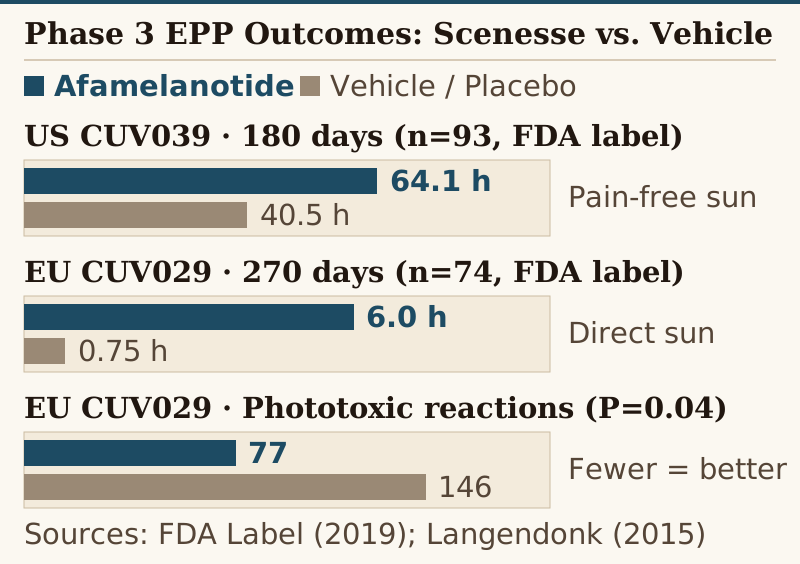
| Trial & Design | Primary / Key Endpoint | Afamelanotide | Vehicle / Placebo | Primary Source |
|---|---|---|---|---|
| US CUV039 (NCT01605136) 180 days · 3 implants |
Median pain-free direct sun, 10 am–6 pm (FDA label, n=93: 48 vs. 45) | 64.1 hours | 40.5 hours | FDA Label (10/2019) |
| US CUV039 (NEJM analysis) 94 randomized |
Median pain-free direct sun after 6 months (P = 0.04) | 69.4 hours | 40.8 hours | Langendonk (2015) |
| EU CUV029 (NCT00979745) 270 days · 5 implants (n=74) |
Median pain-free direct sun, 10 am–3 pm, “most of day” (FDA / NEJM, P = 0.005) | 6.0 hours | 0.75 h (FDA) / 0.8 h (NEJM) | FDA; NEJM |
| EU CUV029 Secondary | Total phototoxic reactions over 9 months (P = 0.04) | 77 reactions | 146 reactions | Langendonk (2015) |
| US Photoprovocation Subgroup (n=21) | Day-90 median minimum symptom dose change (hand / lower back) | +208.3 / +227.5 J/cm² | +56.2 / −2.4 J/cm² | Langendonk (2015) |
Disease-specific EPP-QOL quality-of-life scores rose in the U.S. active group over placebo (+44.0 vs. +23.4 at day 60, P < 0.001; +49.8 vs. +30.4 at day 120, P < 0.001; +51.1 vs. +36.8 at day 180, P = 0.02), though the broader Dermatology Life Quality Index did not change over time in either group (Langendonk et al., 2015).
Safety record, historical label monitoring, and remaining unknowns
Across three randomized vehicle-controlled trials (CUV029, CUV030, and CUV039) enrolling 244 adults with EPP without significant liver involvement (125 Scenesse, 119 vehicle), FDA's October 2019 label reports higher rates with Scenesse for implant-site reactions (21% vs. 10%, most commonly discoloration at 10%), nausea (19% vs. 14%), oropharyngeal pain (7% vs. 5%), cough (6% vs. 3%), fatigue (6% vs. 3%), dizziness (4% vs. 3%), skin hyperpigmentation (4% vs. 0%), and melanocytic nevus (4% vs. 2%). In the two pivotal trials, serious adverse events (four in afamelanotide arms; two in placebo arms, including one melanoma) were deemed unrelated to study drug (Langendonk et al., 2015).
- Historical October 2019 FDA label monitoring statements: FDA's October 2019 prescribing information (Revised: 10/2019) states: “Maintain sun and light protection measures during treatment with SCENESSE to prevent phototoxic reactions related to EPP.” It also states: “A full body skin examination (twice yearly) is recommended to monitor pre-existing and new skin pigmentary lesions.”
- Organ-function limits: EMA's EPAR (last updated October 7, 2026) states: “Scenesse must not be used in patients with reduced liver or kidney function.” FDA's October 2019 label states that “The effect of renal or hepatic impairment on the pharmacokinetics of afamelanotide is unknown” and “No drug interaction studies were conducted with afamelanotide.”
- Unstudied populations and carcinogenicity: FDA's October 2019 label states: “Carcinogenicity studies have not been conducted with SCENESSE” (though Ames, mouse lymphoma, and mouse bone-marrow micronucleus assays were negative), “The safety and effectiveness of SCENESSE have not been established in pediatric patients,” and there are no data in pregnant women or human milk.
- Long-term surveillance: A 2025 dermatology review (disclosing Rhythm Pharmaceuticals editorial support) reports that more than 1,000 patients have been exposed to afamelanotide—many for 5 years and some for more than 10 years—with no melanoma events reported, while cautioning that chronic MC1R activation does not serve as complete prevention.