
Before Arizona: A century of pituitary pigment signals
Melanocortins—peptide hormones cleaved from the precursor protein pro-opiomelanocortin (POMC)—did not originate in cosmetic science. As a 2022 pharmacological review notes, the discovery of melanocortins in 1916 initiated more than 100 years of research focused on these peptides. In 1950, Philip S. Hench, Edward C. Kendall, and Tadeus Reichstein received the Nobel Prize in Physiology or Medicine for discoveries on adrenocorticotropic hormone (ACTH) and adrenal hormones.
ACTH and alpha-melanocyte-stimulating hormone (α-MSH) both regulate distinct physiological pathways—adrenal cortical function and pigmentation, respectively—and native α-MSH is vulnerable to enzymatic breakdown in serum (Sawyer et al., 1980).
1980: Heat, alkali, and the D-Phe7 hinge
The chemical clue came from an established laboratory observation: heat-alkali treatment of native α-MSH prolonged its biological activity. In 1980, Tomi Sawyer, Victor Hruby, Mac Hadley, and colleagues hydrolyzed heat-alkali-treated hormone and traced that longevity to partial racemization—the flipping of an amino acid from its usual left-handed L-shape to its mirror-image D-shape—particularly at positions 4 (methionine) and 7 (phenylalanine). Synthesizing [Nle4, D-Phe7]-α-MSH (replacing methionine-4 with synthetic norleucine and flipping phenylalanine-7 to D-phenylalanine) produced an analog resistant to enzymatic degradation by serum enzymes with prolonged biological activity.
That 1980 paper—still preclinical, grounded in animal and cell models—measured sharply increased activity across three experimental assays: frog skin bioassay, mouse melanoma cell tyrosinase stimulation, and mouse melanoma adenylate cyclase activation, where [Nle4, D-Phe7]-α-MSH was 26 times as potent as native α-MSH in the adenylate cyclase assay. Later literature referred to this linear 13-amino-acid peptide as NDP-α-MSH, Melanotan I (Hadley & Dorr, 2006), and afamelanotide (Scenesse).
1989: Closing the ring into Melanotan II
Nine years later, chemists in the Department of Chemistry at the University of Arizona in Tucson used molecular-dynamics design to synthesize seven cyclic lactam analogs—peptides closed into a chemical loop through an internal amide bridge—and tested them in frog (Rana pipiens) and lizard (Anolis carolinensis) skin bioassays (Al-Obeidi et al., 1989).
Ring size shaped potency sharply. In the lizard skin assay, the 23-membered cyclic analog Ac-[Nle4,Asp5,D-Phe7,Lys10,Gly11]-α-MSH4-13-NH2 showed 100 times the potency of native α-MSH, while the shorter seven-amino-acid 23-membered cyclic peptide Ac-[Nle4,Asp5,D-Phe7,Lys10]-α-MSH4-10-NH2—later named Melanotan-II (MT-II)—had 90 times the potency of native α-MSH in the lizard skin assay. Both 23- and 24-membered rings showed prolonged residual activity that smaller 20-, 21-, and 22-membered rings lacked (Al-Obeidi et al., 1989). As a 2007 review co-authored by Hruby and Hunter Wessells summarized, cyclization prevented degradation and allowed truncation at both ends of the peptide.
1991: Proving UV-free human skin darkening in Tucson
Clinical testing first reached publication for the linear molecule. In 1991, investigators at the University of Arizona Health Sciences Center published a randomized, placebo-controlled, double-blind clinical trial in JAMA enrolling 28 healthy white men with histories of poor tanning (skin types I or II) or good tanning (skin types III or IV). All subjects used a high-potency sunscreen during the 12-day trial, and investigators followed them for 7 weeks after therapy ended while serial chromaticity measurements quantified skin darkening.
Active treatment produced a statistically significant parabolic curve of skin darkening in skin types I–II (P < 0.001) and skin types III–IV (P << 0.001), peaking 1 to 3 weeks after therapy finished, whereas no darkening occurred in subjects given placebo.
1996 and 1998: Controlled clinical trials of Melanotan II
When University of Arizona investigators moved cyclic Melanotan II into controlled human studies—only a few years after the first melanocortin receptor genes were cloned in 1992—clinical observations extended well beyond skin pigment. Two published trials documented those effects separately:
- 1996 pilot Phase I study (n = 3): In a single-blind, alternating-day, placebo-controlled trial in 3 normal male volunteers, Dorr and colleagues observed increased pigmentation of the face, upper body, and buttock in two subjects one week after dosing ended. Investigators also recorded mild nausea not requiring antiemetic treatment, Grade II somnolence and fatigue in one of two subjects at higher study exposure, and a stretching-and-yawning complex that appeared to correlate with intermittent spontaneous penile erections lasting 1 to 5 hours.
- 1998 crossover trial (n = 10): In a double-blind, placebo-controlled crossover study in 10 men with psychogenic erectile dysfunction using real-time RigiScan monitoring, Wessells and colleagues recorded clinically apparent erections in 8 of 10 men treated with Melanotan II. Mean duration of tip rigidity greater than 80% was 38.0 minutes with Melanotan II versus 3.0 minutes with placebo (p = 0.0045), accompanied by transient nausea, stretching and yawning, and decreased appetite more frequently than with placebo, none requiring treatment.
How the early molecules forked into two tracks
Once all five human melanocortin receptors were mapped and shown to share a conserved His-Phe-Arg-Trp sequence across natural POMC agonists, those overlapping clinical findings aligned with receptor cross-reactivity. As Hadley and Dorr noted in 2006, both Melanotan I and Melanotan II were patented and tested clinically—MT-I for tanning studies and MT-II for male erectile dysfunction—while Palatin Technologies advanced the deaminated derivative PT-141 into clinical trials.
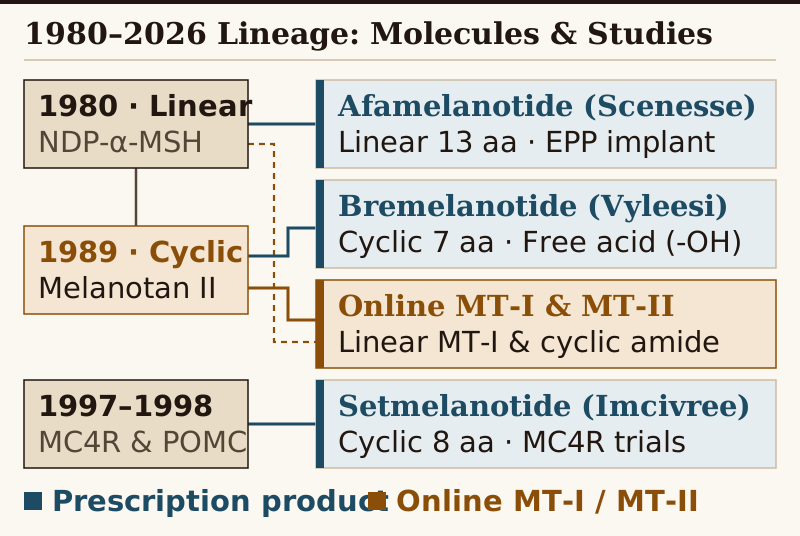
NDP-α-MSH, 1989 cyclic Melanotan II, and 1997–1998 MC4R/POMC genetics to today's prescription medicines (Dry-Sky Slate) and online Melanotan I and II products (Desert Ochre). Sources: Sawyer (1980), Al-Obeidi (1989), Huszar (1997), Krude (1998), EMA, FDA (2019), FDA (2026).Inside regulated clinical development, linear NDP-α-MSH waited 34 years after its discovery before EMA's EPAR (last updated October 7, 2026) recorded: “The European Commission granted a marketing authorisation valid throughout the European Union for Scenesse on 22 December 2014,” followed by FDA's orphan-drug record listing “Marketing Approval Date: 10/08/2019” for afamelanotide (Scenesse). For PT-141, FDA's June 21, 2019 approval letter recorded authorization of bremelanotide (Vyleesi) for premenopausal women with acquired, generalized HSDD. Separately, 1997 mouse MC4R knockouts and 1998 human POMC mutation studies anchored clinical development of setmelanotide (Imcivree), whose FDA prescribing label (Revised: 03/2026) lists “Initial U.S. Approval: 2020.”
Outside regulated clinical medicine, the early academic names entered an unregulated trade documented by dermatologists as products labeled melanotan I and/or II obtained via the internet, tanning salons, and gyms, and later referenced in approximately 3% of analyzed pro-tanning TikTok videos. The underlying receptor family remained identical; only clinical oversight disappeared.