
One functional group from Melanotan II
Bremelanotide (Vyleesi), studied under the code PT-141, is the closest structural relative to Melanotan II in prescription medicine. FDA's June 2019 label describes bremelanotide as a synthetic cyclic heptapeptide (free-base molecular weight 1025.2) with the structure Ac-Nle-cyclo-(Asp-His-D-Phe-Arg-Trp-Lys-OH). Compared directly with Melanotan II (Ac-Nle4-Asp5-His6-D-Phe7-Arg8-Trp9-Lys10-NH2), every amino acid and the cyclic lactam ring match, except bremelanotide replaces the C-terminal amide (-NH2) with a free carboxylic acid (-OH). As King and colleagues wrote in 2007, PT-141 is the deaminated carboxylate derivative and likely metabolite of Melanotan II.
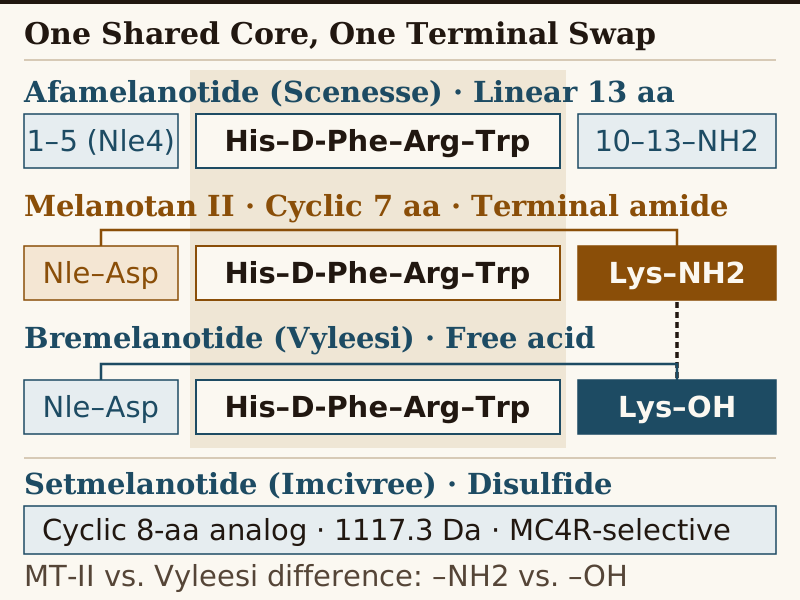
His–D-Phe–Arg–Trp core; replacing Melanotan II's terminal amide (-NH2) with a free acid (-OH) yields bremelanotide. Sources: Dorr (1996); FDA Scenesse Label; FDA Vyleesi Label; FDA Imcivree Label (03/2026).Clinical development and dated June 2019 FDA label text
After University of Arizona clinical trials documented Melanotan II's erectogenic activity (Dorr et al., 1996; Wessells et al., 1998), Palatin Technologies tested PT-141 in male sexual dysfunction (Hadley & Dorr, 2006). In preclinical studies, PT-141 induced erections in rats and nonhuman primates. Researchers measured hypothalamic neuronal activation in rats. In an early Phase 1 randomized, double-blind, placebo-controlled trial of 24 healthy men without erectile dysfunction, PT-141 increased duration of rigid erections on RigiScan monitoring to 140 minutes compared to 22 minutes in the placebo group.
Commercial development later centered on women's sexual health. FDA's NDA 210557 approval letter (dated 06/21/2019) and prescribing information (Revised: 6/2019) state: “VYLEESI is a melanocortin receptor agonist indicated for the treatment of premenopausal women with acquired, generalized hypoactive sexual desire disorder (HSDD) as characterized by low sexual desire that causes marked distress or interpersonal difficulty and is NOT due to: A co-existing medical or psychiatric condition, Problems with the relationship, or The effects of a medication or drug substance.” Under Limitations of Use, the June 2019 label adds: “VYLEESI is not indicated for the treatment of HSDD in postmenopausal women or in men.” “VYLEESI is not indicated to enhance sexual performance.”
Pharmacology and pharmacokinetics
FDA's June 2019 label states that bremelanotide “nonselectively activates several receptor subtypes with the following order of potency: MC1R, MC4R, MC3R, MC5R, MC2R,” adding that at therapeutic dose levels binding to MC1R and MC4R is most relevant and “The mechanism by which VYLEESI improves HSDD in women is unknown.” Following a single subcutaneous administration, absolute bioavailability was about 100%, median Tmax was approximately 1.0 hour (range 0.5–1.0 hours), mean terminal half-life was approximately 2.7 hours (range 1.9–4.0 hours), and mean apparent clearance (CL/F) was 6.5 ± 1.0 L/hr (FDA Label, Revised: 6/2019).
RECONNECT Phase 3 evidence: Modest gains, null SSEs, high dropouts
Two identical 24-week randomized, double-blind, placebo-controlled, multicenter trials—RECONNECT (NCT02333071 Study 301 and NCT02338960 Study 302), funded by Palatin Technologies and AMAG Pharmaceuticals (Kingsberg et al., 2019)—randomized 1,267 premenopausal women (mean age 39 years; 85.6% white; 96.6% U.S. sites). Of those randomized, 1,247 entered the safety population (n = 627 Vyleesi, n = 620 placebo; FDA Label Table 1) and 1,202 entered the modified intent-to-treat (MITT) efficacy population (Kingsberg et al., 2019; Study 1: N = 290 active vs. N = 316 placebo; Study 2: N = 282 active vs. N = 314 placebo).
| Measure (24-Week Double-Blind Period) | Study 1 / 301 | Study 2 / 302 | Primary Source |
|---|---|---|---|
| FSFI Desire Domain vs. placebo (co-primary; 1.2–6.0 scale) | +0.30 (P < 0.001) | +0.42 (P < 0.001) | Kingsberg (2019); FDA Label |
| FSDS-DAO Q13 distress vs. placebo (co-primary; 0–4 scale) | −0.37 (P < 0.001) | −0.29 (P = 0.005) | Kingsberg (2019); FDA Label |
| Satisfying sexual events (SSEs, secondary; mean change) | 0.0 vs. −0.1 (p = 0.76) | 0.0 vs. 0.0 (p = 0.70) | FDA Label (6/2019) |
| Premature trial discontinuation (Vyleesi vs. placebo, MITT) | 40% vs. 13% | 39% vs. 25% | FDA Label (6/2019) |
Both studies achieved statistical significance on co-primary desire and distress scales (integrated differences +0.35 and −0.33, both P < 0.001, Kingsberg et al., 2019). Yet FDA's June 2019 label records two major counterweights: there was no significant difference between groups in the secondary endpoint of satisfying sexual events (p = 0.76; p = 0.70), and premature discontinuation in the MITT population reached 40% vs. 13% in Study 1 and 39% vs. 25% in Study 2—with 18% of the safety set stopping due to adverse reactions versus 2% on placebo.
The spillover ledger: Blood pressure, nausea, and focal pigment
- Cardiovascular contraindication and blood pressure: FDA's June 2019 label states: “VYLEESI is contraindicated in patients who have uncontrolled hypertension or known cardiovascular disease.” Clinical studies recorded maximal transient increases of 6 mmHg systolic and 3 mmHg diastolic blood pressure peaking 2 to 4 hours post-dose, with heart-rate reductions up to 5 beats per minute, usually returning to baseline within 12 hours. In an open-label ambulatory monitoring study of 127 premenopausal women given daily Vyleesi, daytime blood pressure rose by a mean of 1.9 mmHg systolic and 1.7 mmHg diastolic after 8 days.
- Nausea, flushing, and gastric-emptying interaction: In the safety population (n = 627 active vs. n = 620 placebo; FDA Label Table 1), nausea occurred in 40.0% vs. 1.3% (requiring anti-emetics in 13% and causing discontinuation in 8%), alongside flushing (20.3% vs. 0.3%), injection-site reactions (13.2% vs. 8.4%), headache (11.3% vs. 1.9%), and vomiting (4.8% vs. 0.2%). Regarding slowed gastric emptying, FDA's June 2019 label states: “As VYLEESI may significantly decrease the systemic exposure of orally-administered naltrexone, patients should avoid using VYLEESI with an orally administered naltrexone-containing product that is intended to treat alcohol and opioid addiction due to the severe consequence of naltrexone treatment failure.” One acute hepatitis case occurred in an uncontrolled extension after 10 doses over one year (liver tests normalized 4 months after stopping; no broader hepatotoxicity signal appeared).
- MC1R pigment spillover: In intermittent Phase 3 trials, focal hyperpigmentation involving the face, gingiva, and breasts occurred in 1% of treated patients versus 0% on placebo. In a separate daily-dosing study, 38% developed focal hyperpigmentation after 8 days, and, among those who continued for 8 more consecutive days, an additional 14% developed new focal pigment changes—more common in patients with dark skin, with resolution not confirmed in all patients after stopping.