
MC4R signaling regulates food intake and energy balance in mouse knockout studies; FDA's March 2026 label explicitly excludes general (polygenic) obesity.
The cardiovascular hurdle and 20-fold MC4R selectivity
In 1997, targeted gene inactivation in mice showed that disrupting MC4R causes maturity-onset obesity with hyperphagia, hyperinsulinemia, and hyperglycemia; a year later, Krude et al. (1998) documented human POMC mutations pairing early-onset obesity with adrenal insufficiency and red hair. Early clinical MC4R obesity candidates—MK-0493, LY2112688, MC4-NN-0453, and AZD2820—failed in human trials despite preclinical efficacy, with purported MC4R-selective compounds identifying hypertension, increased heart rate, skin darkening, and sexual arousal.
Setmelanotide (Imcivree) is an 8-amino-acid cyclic disulfide peptide analog of α-MSH (C49H68N18O9S2, free-base mass 1117.3 Daltons; median tmax 8 hours, effective elimination half-life ~11 hours, no clinically relevant QT prolongation). FDA's March 2026 label describes it as an MC4R agonist with 20-fold less activity at MC3R and MC1R; in human-receptor assays compiled by Yuan & Tao (2022) (Kievit et al., 2013), EC50 is 0.27 nM at MC4R versus 5.3 nM (MC3R), 5.8 nM (MC1R), and 1600 nM (MC5R). Preclinical work summarized by Yuan & Tao indicates setmelanotide potently activates MC4R Gαq signaling resistant to AgRP antagonism, reducing food intake without cardiovascular pressor effects.
Dated U.S. FDA and EU EMA indications and eligibility boundaries
United States (FDA Prescribing Information; Initial U.S. Approval: 2020; Revised: 03/2026): “IMCIVREE is a melanocortin 4 (MC4) receptor agonist indicated to reduce excess body weight and maintain reduction long term in adults and pediatric patients aged (1): 4 years and older with acquired hypothalamic obesity (HO). 2 years and older with Bardet-Biedl syndrome (BBS). 2 years and older with pro-opiomelanocortin (POMC), proprotein convertase subtilisin/kexin type 1 (PCSK1), or leptin receptor (LEPR) deficiency confirmed by genetic testing demonstrating variants in POMC, PCSK1, or LEPR genes that are interpreted as pathogenic, likely pathogenic, or of uncertain significance (VUS).” The label notes: “An FDA-approved test for the detection of variants in the POMC, PCSK1, or LEPR genes is not available.” Under Limitations of Use: “IMCIVREE is not indicated for the treatment of patients with the following conditions as IMCIVREE would not be expected to be effective: Obesity due to suspected POMC, PCSK1, or LEPR deficiency with POMC, PCSK1, or LEPR variants classified as benign or likely benign. Other types of obesity not related to acquired HO, BBS, or POMC, PCSK1 or LEPR deficiency, including obesity associated with other genetic syndromes and general (polygenic) obesity.”
European Union (EMA EPAR; Last updated: 27/05/2026; latest procedure affecting product information dated 30/04/2026): “Imcivree received a marketing authorisation valid throughout the EU on 16 July 2021.” The EPAR update states Imcivree is used “in adults and children aged 4 years and older with acquired hypothalamic obesity (aHO), a condition that occurs when the hypothalamus (a part of the brain) does not work properly, either following an injury or because of an underlying disease;” “in adults and children aged 2 years and older who have pro-opiomelanocortin (POMC) deficiency, proprotein convertase subtilisin/kexin type 1 (PCSK1) deficiency, or leptin receptor (LEPR) deficiency; these genetic conditions result from changes (mutations) in both copies of the genes responsible for making POMC, PCSK1 or LEPR;” and “in adults and children aged 2 years and older with a genetic condition called Bardet Biedl syndrome (BBS).”
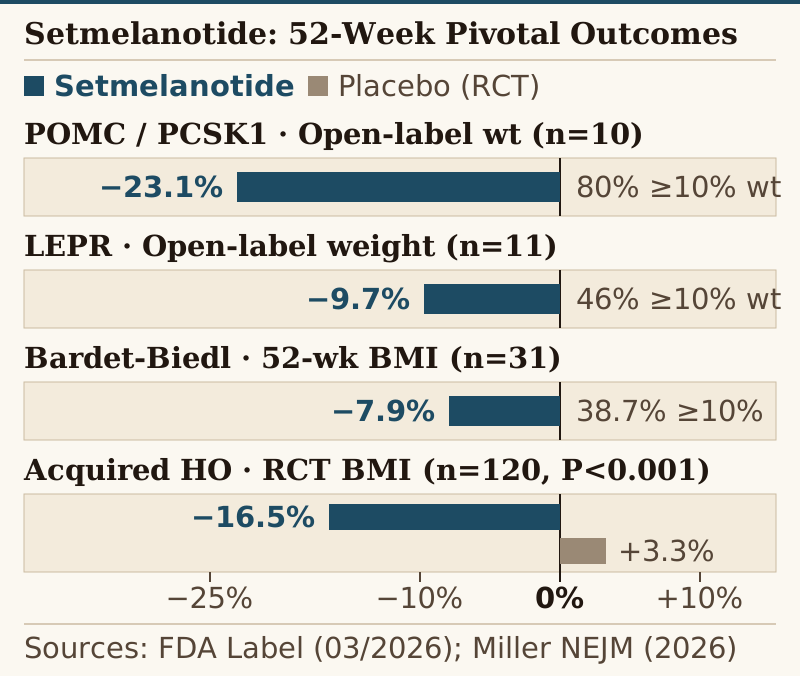
Pivotal Rhythm Pharmaceuticals–funded trials
Trials 3 and 4 (ages ≥6) enrolled patients with homozygous or presumed compound heterozygous variants and excluded double heterozygotes in two different genes (FDA Label 03/2026); Clément et al. (2020) reported most-hunger changes of −27.1% (n = 7, p = 0.0005) in POMC and −43.7% (n = 7, p < 0.0001) in LEPR, while 4-week blinded placebo withdrawal in 16 responders produced 5.5 kg and 5.0 kg average regain (FDA Label 03/2026). In Trial 2 (ages ≥6), Haqq et al. (2022) saw 32.3% of BBS patients ≥12 reach ≥10% weight loss at 52 weeks (p = 0.0006; Alström inconclusive), and FDA's label reports 14-week placebo-adjusted BMI change of −4.5% (N = 44 BBS). Open-label Trial 5 (NCT04966741; ages 2 to <6; N = 12: 3 POMC, 4 LEPR, 5 BBS, none PCSK1) showed 52-week BMI changes of −33.8%, −13.1%, and −9.7% (8% discontinuation; FDA Label 03/2026). In acquired HO (TRANSCEND / Trial 1), Miller et al. (July 9, 2026) reported a 52-week LSM BMI change of −16.5% vs. +3.3% (P < 0.001) and, in participants aged 12 or older, a change in the weekly average of maximal daily hunger of −2.73 vs. −1.45 (P = 0.009), while FDA's label reported 60.99% vs. 4.69% reaching ≥10% BMI loss (10.6% vs. 12.5% discontinuation).
| Indication & Trial | Design & Cohort | 52-Week Primary / Key Outcome | Primary Source |
|---|---|---|---|
| POMC / PCSK1 (Trial 3, NCT02896192) | Open-label + 8-wk withdrawal (n = 10, ages ≥6) | 80% ≥10% wt; mean −23.1% wt (P = 0.0003) | FDA (03/2026); Clément (2020) |
| LEPR (Trial 4, NCT03287960) | Open-label + 8-wk withdrawal (n = 11, ages ≥6) | 46% (45% Clément) ≥10% wt; mean −9.7% wt (P = 0.0074) | FDA (03/2026); Clément (2020) |
| Bardet-Biedl (Trial 2, NCT03746522) | 14-wk RCT + 52-wk open-label (N = 31 BBS, ages ≥6) | Mean −7.9% BMI; 38.7% ≥10% BMI (Alström inconclusive) | FDA (03/2026); Haqq (2022) |
| Acquired HO (Trial 1 / TRANSCEND, NCT05774756) | Double-blind RCT with a 52-week treatment period after titration (n = 120 NEJM / N = 142 FDA, ages ≥4) | −16.5% vs. +3.3% BMI (NEJM, P < 0.001); −18.40% diff (FDA) | Miller (2026); FDA (03/2026) |
The March 2026 FDA label says its trials included no patients aged 65 or older. The published TRANSCEND trial included participants aged 4 to 66. FDA's label also notes no pregnancy data, recommends against breastfeeding, does not recommend use in end-stage renal disease (eGFR <15 mL/min/1.73 m²), and notes short-term testing in 12 otherwise healthy patients with obesity is not an approved use.
Cross-receptor footprint, mood, and 2026 endocrine warnings
- MC1R pigment and moles: Skin hyperpigmentation occurred in 58% vs. 10% placebo in acquired HO (N = 142), 63% in BBS (N = 43), 78% in POMC/PCSK1/LEPR (N = 27), and 83% in ages 2 to <6 (N = 12; FDA Label 03/2026), with pooled rates on FDA's December 2024 label reported as 67% (ages ≥6) and 83% (ages 2 to <6). Melanocytic nevi occurred in 14% to 19% across older cohorts and 33% in Trial 5 (FDA Label 03/2026); FDA directs full-body skin exams before and during therapy. A 2025 review (Rhythm Pharmaceuticals editorial support) reported two fair-skinned Fitzpatrick II BBS patients with heavy UV exposure diagnosed with stage pT1a melanoma, both excised.
- Erections, mood, and hypersensitivity: Spontaneous penile erections occurred in 23% (n = 13 males, Trials 3–4), 25% (n = 20 males, BBS), and 8% (Trial 5; FDA Label 03/2026)—and, in acquired HO, spontaneous erections or increased erection frequency were reported in 7% of the treated group and 4% of the placebo group (FDA Label 03/2026); pooled December 2024 label figures include 24% in males ≥6 and 7% sexual adverse reactions in females ≥6. Trials 3–4 recorded depression (26%) and suicidal ideation (11%), and Trial 5 recorded depressed mood (8%; FDA Label 03/2026). Imcivree is contraindicated after prior serious hypersensitivity, including postmarketing anaphylaxis.
- 2026 acquired HO warnings: In TRANSCEND, adverse events occurred in 100% vs. 90% and serious adverse events in 28% vs. 8% (Miller et al., 2026). FDA's March 2026 label added warnings for acute adrenal insufficiency (serious reactions in 5% vs. 0% placebo among patients with secondary adrenal insufficiency) and sodium imbalance (6% vs. 2% hyponatremia; 5% vs. 4% hypernatremia in central diabetes insipidus). Across five ≥52-week trials, 4/245 (1.6%) developed anti-setmelanotide and 17/245 (6.9%) anti-α-MSH antibodies (generally low titers; clinical impact undetermined); 26-week Tg.rasH2 mice showed no carcinogenicity.